
Table of Contents
Outpatient Rehab in Newport Beach: A Path to Lasting Recovery
Outpatient rehab in Newport Beach offers a flexible, evidence-based approach for individuals ready to address substance use while maintaining their daily lives. This model allows clients to attend structured therapy sessions at a licensed facility during the day and return home each evening, making it ideal for those with moderate needs and a stable home environment.
Choosing this level of care provides a significant local advantage for Newport Beach residents. Individuals can access high-quality treatment without uprooting their lives, preserving crucial family connections, employment responsibilities, and personal routines that are essential for long-term recovery stability.
Unlike residential treatment, which provides 24-hour supervision in a live-in setting, outpatient care offers daytime flexibility. It often serves as a step-down after detox or a residential stay, or as an independent entry point. Residents seeking outpatient rehab in newport beach can attend day sessions before returning to their families, a key advantage supported by modern dual diagnosis treatment newport beach that simultaneously addresses co-occurring mental health conditions for more effective outcomes.
This journey represents a path to lasting recovery through continuity of care. A comprehensive outpatient plan, including an IOP Newport Beach track, incorporates step-down levels and relapse prevention for enduring stability. Blue Coast Behavioral Health’s Newport Beach facility offers this full continuum, providing a blue coast behavioral health newport beach option for local residents who are ready to begin the next chapter. Where you are, we are.
Levels of Outpatient Care in Newport Beach: PHP vs. IOP Explained
Two primary levels of care form the backbone of outpatient rehab Newport Beach has to offer: Partial Hospitalization Programs and Intensive Outpatient Programs. Each is designed to meet different needs and provide a structured path to recovery without requiring a residential stay. Understanding the differences is the first step toward choosing the right starting point for you.
What Is a Partial Hospitalization Program (PHP)?
A Partial Hospitalization Program (PHP) is the highest level of outpatient care available. It provides a structured day of therapy and medical monitoring in our clinical office setting, but you return home in the evening. This structure makes it an ideal step-down from inpatient detox or residential treatment, offering intensive daily support while you begin reintegrating into your home life. At our program, you can expect to spend 6-8 hours per day, 5-6 days per week, engaging in individual therapy, group therapy, and skill-building sessions. Therapies like CBT, DBT, and the Matrix Model are woven into your schedule, and dual-diagnosis care is integrated to address co-occurring conditions like anxiety or depression at this level.
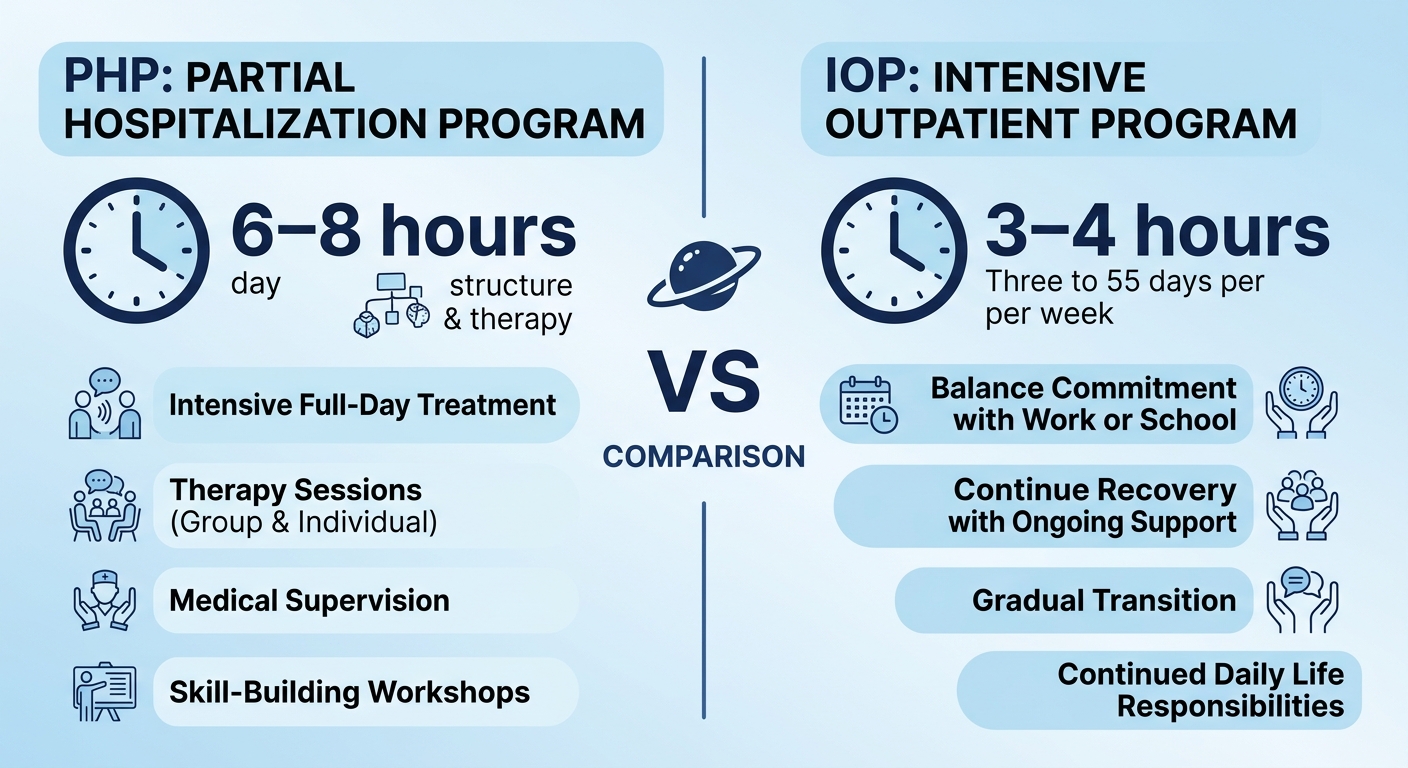
A side-by-side comparison of PHP and IOP outpatient care programs in Newport Beach.
What Is an Intensive Outpatient Program (IOP)?
An IOP offers a less intensive schedule designed for those who need structured support but must maintain work, school, or family commitments. Typically requiring 3-4 hours per day, 3-5 days per week, our intensive outpatient alcohol program in Orange County is available in both morning and evening tracks to fit your life. This level of care is often the next step after completing PHP, but it also serves as an effective starting point for individuals with moderate alcohol use disorders who have a stable home environment. You will participate in many of the same evidence-based therapies–group therapy, relapse prevention groups, and individual sessions–while continuing to receive dual-diagnosis support for any co-occurring mental health needs.
How to Choose Between PHP and IOP
Determining the best level of care for your needs depends on several key factors that we help you evaluate during your initial assessment. Consider your current situation:
- Substance Use Severity and Recent History: Those stepping down from residential treatment or who need full-day structure often begin with PHP. For others, a less intensive option may be more appropriate.
- Co-Occurring Conditions: If you are managing significant anxiety, depression, or trauma alongside alcohol dependence, the higher structure of a PHP can provide more immediate dual diagnosis treatment in Newport Beach before transitioning to IOP’s flexible schedule.
- Work, School, and Family Obligations: An IOP program, with its evening options, is designed for individuals who cannot pause their daily responsibilities, allowing you to receive care while continuing to work or attend school.
- Home Environment Stability: We have found that individuals living in supportive, sober environments often thrive in IOP directly. If your home environment presents challenges, the intensive daily structure of PHP provides greater containment during the early stages of recovery.
You do not need to make this decision alone. Many clients begin their journey by visiting our orange county addiction treatment center to tour the facility and see for themselves how each level operates. Understanding these options is an important first step, and a caring member of our team can help you determine the right entry point so you can Pursue the Freedom of Recovery.
† This content is for informational purposes and is not a substitute for professional medical advice. Always consult a healthcare provider for your specific situation.
How Outpatient Rehab Works in Newport Beach for Clients Living at Home
For clients in Newport Beach who live at home, our outpatient programs are designed to fit into your existing routine while providing the structure needed for lasting newport beach recovery. We understand that stepping into treatment can feel overwhelming, but outpatient rehab in Newport Beach offers a practical path that doesn’t require putting your life on hold. Our approach at Blue Coast Behavioral Health is built around flexibility, evidence-based care, and the belief that healing happens within the context of your daily world.
The Outpatient Schedule: A Typical Week at Blue Coast Behavioral Health
A typical week in our IOP Newport Beach program involves nine or more hours of structured therapy, thoughtfully distributed across three to five days. This schedule is designed to provide intensive support while allowing you to maintain your presence at home, at work, or in school. A client might start their week with an individual therapy session on Monday, attend a process group on Wednesday evening, and join a family check-in session on Saturday morning. For those balancing a 9-to-5 job, our popular 6:30 PM group sessions ensure that treatment is accessible after business hours. Throughout the week, the therapeutic focus includes exploring personal triggers, developing coping skills, and building a community of sober support. This consistent rhythm creates a reliable framework that clients can depend on during the vulnerable early weeks of recovery.
Balancing Treatment with Work, School, and Family Life
We recognize that most of our clients are not just managing their recovery; they are also managing professional responsibilities, academic deadlines, and family commitments. To support this balancing act, we offer flexible morning and evening group options specifically designed for Newport Beach residents. A client might, for example, drop their children at school, attend a 10:00 AM process group, and still make it to the office by midday. Others may prefer to connect with their therapist via a tele-therapy session during a lunch break, eliminating the need to commute across the peninsula. We also find that integrating the family into the treatment process through regular weekly progress updates–always coordinated with the client’s consent–helps distribute the emotional weight of recovery. By coordinating schedules and communicating openly, it is possible to pursue healing without stepping away from life’s essential roles.
Creating a Supportive Home Environment for Recovery
A stable, substance-free living environment is a cornerstone of outpatient success. The most effective recovery happens when the physical space you return to each evening reinforces your treatment goals rather than undermining them. This often means having candid conversations with family members or housemates about keeping the home free of alcohol, securing medications, and setting clear boundaries around guests and social activities. We encourage family involvement through weekly progress updates because we believe that healing does not happen in isolation. When loved ones understand what you are working on in therapy, they are better equipped to offer encouragement instead of accidental triggers. Setting these boundaries early creates a sanctuary where you can process the day’s therapeutic work and practice new coping skills in real time.
Tele-Therapy: Access Care from Your Newport Beach Home
For clients who need greater scheduling flexibility, our HIPAA-compliant tele-therapy option brings the therapeutic space directly into your Newport Beach home. This reduces the travel time associated with navigating the Newport Beach peninsula and can make treatment more accessible during periods of high professional or family demand. Tele-therapy is not simply a convenience; it is a fully integrated clinical tool that allows our team to maintain continuity of care. For individuals also receiving dual diagnosis treatment in Newport Beach, the ability to connect remotely can be crucial in managing symptoms of co-occurring mood disorders when leaving the house feels difficult. As we like to say, “Where you are, we are.” Whether you are in the office or at your kitchen table, our commitment is to meet you in that space and move forward together.
Dual Diagnosis Treatment in Newport Beach: Addressing Co-Occurring Disorders
Because substance use often co-occurs with mental health conditions, dual diagnosis treatment is a core component of our outpatient rehab Newport Beach clients rely on. This approach delivers simultaneous, integrated care for substance use disorder and a mental health condition such as anxiety, depression, or trauma. According to the Substance Abuse and Mental Health Services Administration (SAMHSA), co-occurring disorders affect roughly half of all individuals with a substance use disorder, making comprehensive care essential. Our clinical team embraces this reality by weaving mental health support into every phase of recovery, so no condition goes untreated.
What Is Dual Diagnosis Treatment?
Dual diagnosis treatment is simultaneous, integrated care for a substance use disorder and a co-occurring mental health condition. Instead of siloing addiction care and psychiatric care in separate silos, one coordinated team manages both diagnoses together. The Substance Abuse and Mental Health Services Administration’s TIP 42 framework defines this approach as best practice because the presence of untreated anxiety, depression, or trauma can destabilize sobriety. In our setting, licensed clinicians assess each client for underlying mood or thought disorders during intake and continue monitoring throughout the program. This means a client working on alcohol dependence and generalized anxiety receives therapy targeting both conditions in every session. By treating the whole person, integrated plans close the gaps that fragmented care often leaves behind.
Why Integrated Care Improves Recovery Outcomes
Research shows that tackling substance use and mental health conditions together produces stronger, longer-lasting recovery. SAMHSA guidelines note that integrated programs lower the risk of relapse because clients learn coping strategies that address both drinking urges and the emotional triggers that fuel them. The National Association of Addiction Treatment Providers (NAATP) reinforces that coordinated care improves overall functioning–clients report healthier relationships, steadier employment, and fewer psychiatric hospitalizations after dual diagnosis treatment. When a client participates in an integrated outpatient program Newport Beach clinicians design, every therapeutic contact checks in on both substance use and mood symptoms. This consistent, unified attention prevents the dangerous cycle where undetected depression derails sobriety or where unchecked substance use exacerbates mental health symptoms. The evidence is clear: treating the whole person yields better results than treating isolated diagnoses.
Evidence-Based Therapies Used in Dual Diagnosis Treatment
Dual diagnosis care draws on a toolkit of proven modalities that address the interplay between addiction and mental health. The following table outlines the core therapies our clinicians use in daily practice:
| Feature | PHP (Partial Hospitalization Program) | IOP (Intensive Outpatient Program) |
|---|---|---|
| Structure and Location | Operates from a clinical office (e.g., Blue Coast Behavioral Health in Newport Beach), offering a highly structured daily schedule. | Operates from the same clinical setting but with a less intensive schedule, often with flexible morning or evening slots. |
| Daily Time Commitment | 6-8 hours/day, 5-6 days per week, similar to a full-time work schedule. | 3-4 hours/day, 3-5 days per week, allowing work or school during non-treatment hours. |
| Typical Length of Stay | 4-6 weeks on average before stepping down to IOP or outpatient. | 8-12 weeks on average, though duration is individualized. |
| Best Suited For | Individuals needing intensive daily structure but who do not require 24/7 residential monitoring. | Individuals with moderate substance use disorders who have a stable home environment and can manage more independence. |
| Therapies Offered | CBT, DBT, Matrix Model, individual therapy, group therapy, family programming, life skills, and relapse prevention. | CBT, DBT, Matrix Model, individual therapy, group therapy, family programming, life skills, and relapse prevention. |
| Insurance & Cost | Typically covered by PPO and many HMO plans; often has a higher daily cost than IOP. | Generally covered by most commercial insurance plans; often lower daily cost than PHP. |
Understanding Cost, Insurance Coverage, and Accessing Care
When exploring outpatient rehab in Newport Beach, the next logical concern after understanding program types is the practical matter of cost and access. We at Blue Coast Behavioral Health believe that financial considerations should never be a barrier to receiving high-quality, evidence-based care. Most people find that their health insurance provides substantial coverage for intensive outpatient services, making the process more accessible than they expected.
How Much Does Outpatient Rehab Cost in Newport Beach?
The cost of partial hospitalization and intensive outpatient programs varies based on the level of medical oversight, duration of daily sessions, and your unique clinical needs. However, the vast majority of our clients find that their insurance plan covers a significant portion, if not all, of the treatment cost. Instead of focusing on specific dollar amounts, we encourage you to use our free insurance verification process, which provides a clear, confidential picture of your out-of-pocket responsibility before you commit to any program.
Does Insurance Cover Outpatient Addiction Treatment?
Yes, most major insurance plans include coverage for outpatient addiction treatment, which is a standard part of behavioral health benefits. This includes policies that cover IOP in Newport Beach, PHP, and medication-assisted treatment at our facility. When you call us, our admissions team conducts a no-cost insurance verification on your behalf, identifying exactly what your plan covers and any associated costs.
How to Start Your Sobriety Journey with Blue Coast Behavioral Health
Beginning treatment is a straightforward, four-step process designed to get you into the right level of care quickly.
- Initial Confidential Call: You speak directly with a caring admissions counselor who listens to your story, answers immediate questions, and gathers preliminary information about your needs.
- Free Insurance Verification: With permission, we contact your provider to determine exact coverage, any co-pays, or deductibles that apply, giving you total financial clarity.
- Clinical Assessment: You attend a comprehensive evaluation with a licensed clinician who assesses for substance use patterns and co-occurring conditions, ensuring any need for dual diagnosis treatment in Newport Beach is identified and integrated into the care plan.
- Program Enrollment: After finalizing the appropriate level of care, we schedule your first therapy session and orientation, welcoming you into our supportive community.
Frequently Asked Questions About Outpatient Rehab in Newport Beach
What are the typical hours and time commitment for outpatient rehab in Newport Beach?
We structure our programs around real-world responsibilities, with our Partial Hospitalization Program in Newport Beach typically requiring 3-4 hours daily and our Intensive Outpatient Program closer to 2-3 hours, letting you balance recovery with work or family.
How does outpatient rehab handle co-occurring mental health conditions?
Our dual diagnosis treatment in Newport Beach delivers integrated care that addresses substance use and mental health concerns simultaneously within the same clinical team.
Can I continue working or attending school while in an outpatient program?
Yes, our IOP in Newport Beach is specifically designed for flexibility, with morning and evening session tracks available so you can maintain employment or academic commitments.
Take the Next Step Toward Recovery in Newport Beach
Recovery is an active pursuit, and our team at Blue Coast Behavioral Health is here to help you take the first step through local outpatient care in Newport Beach. Call (949) 502-2041 now.
Resources
Find Secure Anonymous Treatment for Addiction and Mental Health
Find SAMHSA Behavioral Health Resources and Treatment Locators
Access NAATP Resource Library for Addiction Treatment Professionals
Find California DHCS Residential Substance Use Disorder Services

Newport Beach
CA
92660