
Table of Contents
Finding the Right Drug Rehab in Costa Mesa
When searching for a drug rehab in Costa Mesa, it is essential to evaluate key factors beyond first impressions. We recommend starting with a verification of state licensing and national accreditation, such as CARF or JCAHO. A facility displaying these credentials demonstrates a commitment to established standards of care.
Understanding the levels of care is the next step. Programs range from medically supervised detox and residential treatment to more flexible options like a Partial Hospitalization Program (PHP) and Intensive Outpatient Program (IOP). For those who do not require 24/7 supervision, an outpatient rehab in Orange County can provide structured therapy while allowing you to maintain daily responsibilities. We also encourage you to confirm whether a center specializes in dual-diagnosis treatment, which is critical for addressing any co-occurring mental health conditions that may be fueling addiction.
As you call potential centers, ask about insurance verification, family support programs, and the possibility of a facility tour. A SAMHSA-recognized program serves as a strong indicator of quality, and the Substance Abuse and Mental Health Services Administration (SAMHSA) offers a national helpline to help verify your options. By focusing on these practical details, you can confidently choose a drug rehab in Costa Mesa that aligns with your personal recovery goals.
Understanding Drug Rehab Programs in Costa Mesa
When exploring treatment options in Costa Mesa, it’s important to understand the different levels of care available. Choosing the right drug rehab Costa Mesa has to offer can feel overwhelming, but the process becomes clearer when you know the basic structure of a program. Most treatment plans follow a continuum, starting with stabilization and moving toward increasing independence. The goal is to provide the right amount of support at each stage, addressing both the physical and psychological aspects of addiction.
Detox and Inpatient vs. Outpatient Care
Medical detox is often the first step, providing a supervised environment where the body clears substances safely. This process typically lasts 3 to 7 days, with clinical staff monitoring vital signs and managing withdrawal symptoms. Detox alone is not a cure, but it prepares a person for the deeper work of rehabilitation.
Following detox, inpatient or residential treatment offers 24/7 structured care with room and board, usually lasting 30 to 90 days. This level is suited for severe addictions or unstable home environments, as it removes a person from triggers and surrounds them with support. For those needing around-the-clock structure, exploring options for inpatient rehab orange county can be a crucial step toward stability. In the broader drug and alcohol rehab Orange County network, these residential settings provide a foundation of safety for early recovery.
For individuals ready to live at home while continuing treatment, outpatient levels bridge the gap. A Partial Hospitalization Program provides the most structure, often running 5 to 7 days a week for 6 or more hours daily. An Intensive Outpatient Program offers a flexible step-down, typically meeting 3 to 5 days a week for around 3 hours. This outpatient rehab Orange County model allows clients to practice new skills in their daily lives while maintaining a strong clinical connection.
Evidence-Based Therapies Used in Local Treatment Centers
Costa Mesa rehab programs rely on therapies tested and proven to support lasting recovery. Cognitive Behavioral Therapy helps individuals identify and change the negative thought patterns that drive substance use. By recognizing these automatic thoughts, you develop healthier emotional and behavioral responses to stress and cravings. Dialectical Behavior Therapy builds on this by teaching practical skills for emotional regulation and distress tolerance. This approach is particularly effective for those who experience intense feelings, helping them navigate interpersonal challenges without turning to substances.
The Matrix Model is another cornerstone of many Orange County drug and alcohol treatment plans. This structured 16-week outpatient protocol combines cognitive-behavioral principles, family education, and regular urine testing to create a comprehensive recovery framework. It provides a clear, predictable path that guides individuals through early sobriety, fostering accountability and skill-building in a supportive setting.
The Dual Diagnosis Approach for Co-Occurring Conditions
Dual diagnosis treatment addresses a critical reality: many people with a substance use disorder are also living with a co-occurring mental health condition. Conditions like anxiety, depression, or PTSD can fuel addiction, and vice versa. A dual diagnosis means treating both challenges simultaneously, rather than addressing one and hoping the other resolves on its own. This integrated care model recognizes that lasting recovery must heal the whole person.
Concurrent treatment matters because untreated mental health symptoms are one of the most common triggers for relapse. According to the SAMHSA National Helpline, a free and confidential government resource, anyone can call 1-800-662-HELP (4357) to connect with local treatment facilities that offer integrated services. We believe effective rehab must never be a one-size-fits-all approach. With this foundational understanding of rehab program types, let’s look at what specific services are offered locally to support your unique journey.
Disclaimer: This content is not a substitute for professional medical or psychiatric care. If you are in crisis, call 9-1-1 or your local emergency services immediately.
Key Benefits of Choosing Drug Rehab in Costa Mesa
Beyond understanding what rehab entails, choosing a location like Costa Mesa brings distinct advantages. Deciding to seek drug rehab Costa Mesa residents trust means accessing a comprehensive, individualized system of care designed to support lasting change. At Blue Coast Behavioral Health, we build our approach around three foundational benefits: personalized treatment plans within a seamless continuum of care, robust family support woven into community connection, and flexible outpatient options that allow you to maintain your work and life responsibilities. This is your opportunity to begin a transformative journey and Pursue the Freedom of Recovery.
Personalized Treatment Plans and Continuum of Care
The most significant structural advantage of choosing professional treatment is a true continuum of care, a model endorsed by the Substance Abuse and Mental Health Services Administration (SAMHSA) for its effectiveness in supporting long-term recovery. Our process typically moves through integrated phases, allowing for a personalized step-down approach:
- Medical Detoxification: Supervised withdrawal management to ensure safety and comfort.
- Residential or Partial Hospitalization: Structured daily therapy for intensive skill-building.
- Intensive Outpatient Program (IOP): Flexible therapy sessions that support a transition back to daily life.
- Aftercare Planning: Ongoing alumni groups and relapse prevention strategies for sustained support.
Personalized plans are the cornerstone of this process. We recognize that substance use disorders often co-occur with conditions like anxiety or depression. Our clinical team therefore tailors every plan to address dual diagnosis needs, integrating evidence-based therapies that treat the whole person, not just the addiction. Anyone can verify our facility’s credentials or find additional treatment resources through the SAMHSA National Helpline, a government tool for identifying quality programs across the country.
Family Support and Community Connection
Recovery doesn’t happen in isolation. Our program places a strong emphasis on healing the family system because research consistently shows that family participation improves communication and significantly reduces the risk of relapse. Connecting with local community resources strengthens addiction recovery costa mesa and builds a resilient support network. Through dedicated family programming and weekly progress updates, we help rebuild trust and equip loved ones with the tools to support, rather than enable, the recovery process.
This clinical support is powerfully supplemented by a vibrant local recovery community. Costa Mesa is home to numerous 12-step fellowships, including Alcoholics Anonymous and Narcotics Anonymous meetings, offering a free, accessible layer of peer support. Engaging with these groups allows our patients to forge new, healthy relationships and find sponsorship, creating a community connection that endures long after the formal treatment phase ends.
Flexible Outpatient Options for Work and Life
Seeking help shouldn’t require you to put your entire life on hold. For this reason, our drug and alcohol rehab in Orange County includes flexible care levels that adapt to your schedule, not the other way around. Our Intensive Outpatient Program (IOP) and Partial Hospitalization Program (PHP) are designed with evening and daytime tracks, allowing you to attend several hours of clinical therapy per week while still fulfilling employment, academic, or family obligations. This real-world application of new skills in your daily environment reinforces recovery in a way that isolated treatment often cannot.
Our outpatient rehab in Orange County provides a structured yet adaptable therapeutic environment. Patients practice coping strategies in real time, immediately applying insights from Cognitive Behavioral Therapy (CBT) or Dialectical Behavior Therapy (DBT) sessions. For those who need a structured, substance-free living environment during this phase, exploring options for sober living in Costa Mesa can provide a supportive transition. With these key benefits in mind, the following section details the evidence-based therapies that make recovery possible.
This site and its content are not a substitute for professional medical or psychiatric care.
How the Intake and Treatment Process Works
Understanding the path to recovery can make all the difference. If you are looking for drug rehab in Costa Mesa, our Orange County facility provides a clear, step-by-step process to help you transition from crisis to stability. Once you understand our program options, here is exactly how the intake and treatment process works at Blue Coast Behavioral Health. We guide you through each phase with warmth and clinical precision.
Initial Assessment and Insurance Verification
Your journey begins with a confidential phone call. Our compassionate intake specialist will listen to your story, understand your immediate concerns, and gather essential background information. We then schedule a comprehensive clinical assessment with a licensed therapist who explores your substance use history, mental health status, and personal recovery goals. At the same time, our team completes an in-house insurance verification at no cost. According to the Substance Abuse and Mental Health Services Administration (SAMHSA), most major insurance plans provide coverage for behavioral health services. From this first interaction, we demonstrate our core philosophy: wherever you are on your journey, we are ready to meet you there.
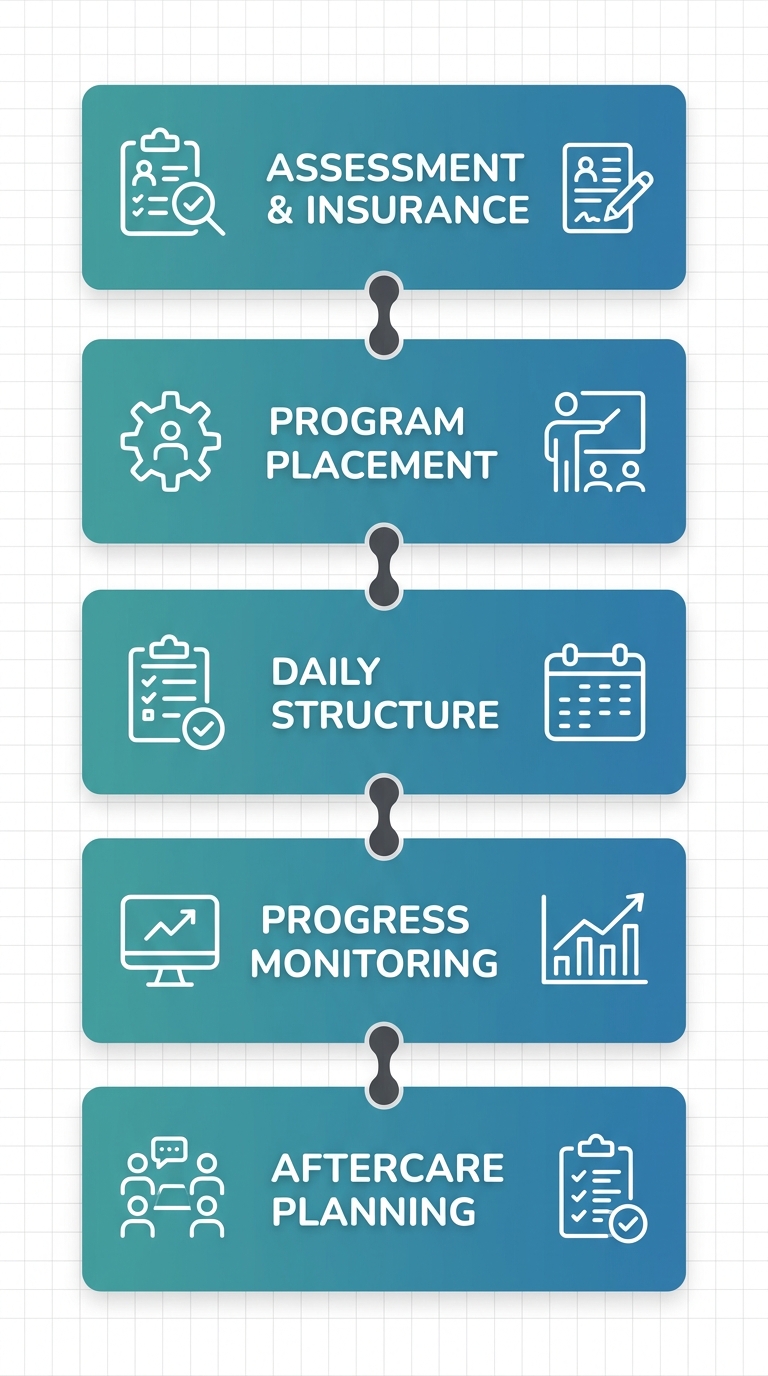
Addiction treatment intake process at Blue Coast Behavioral Health in Orange County.
Program Placement and Duration of Care
With the assessment results and insurance details in hand, our clinical team uses nationally recognized ASAM criteria to recommend the most appropriate level of care. Whether the recommendation is medical detox, residential treatment, a Partial Hospitalization Program (PHP), or an Intensive Outpatient Program (IOP), the decision is always anchored in your individual needs. Typical timeframes for drug and alcohol rehab in Orange County can vary, but we generally outline supportive structures based on clinical benchmarks. Medically supervised detox often lasts 5 to 7 days. Residential treatment programs typically span 30 to 90 days. Our PHP can run 4 to 6 weeks, while our IOP commitment is usually 8 to 12 weeks. These durations are flexible benchmarks, not rigid contracts, and are reviewed weekly with your primary therapist.
The following table compares key factors between inpatient and outpatient care to further clarify these options.
| Factor | Inpatient / Residential | Outpatient (IOP/PHP) |
|---|---|---|
| On-site housing | Live at home or sober living | |
| 24/7 (live-in) | 10-30 hours | |
| Severe addiction, unstable home environment | Mild to moderate addiction, work/family | |
| Higher cost; often covered by insurance | Lower cost; often covered by insurance | |
| Limited visiting hours | Regular family sessions possible |
As the SAMHSA National Helpline confirms, insurance coverage for these distinct levels of care is a common pathway to making treatment affordable. This clarity empowers you to choose the path that best aligns with your life responsibilities and clinical severity, while our team ensures the choice is clinically sound.
Daily Structure in Outpatient and Residential Settings
Life in our residential program is built on therapeutic rhythm. A typical day begins with a morning check-in and community meeting, followed by group therapy and an individual session that deepens personal insight. Afternoons feature skill-building workshops and wellness activities like our signature float therapy. Evenings often involve 12-step meetings or recovery-focused peer support, solidifying the day’s clinical work. Our outpatient addiction recovery orange county program offers a structured yet flexible daily schedule for those balancing treatment with outside commitments. For IOP, clients attend 3 to 5 sessions per week, each running 3 to 4 hours, covering therapy, relapse prevention, and practical life skills while living at home. This supportive framework allows you to apply new coping strategies in real-world settings immediately. Throughout every stage of substance use treatment, our dedicated team remains by your side with 24/7 counselor access.
Best Practices for Choosing and Succeeding in Rehab
Selecting the right rehabilitation program is a pivotal step that directly influences your recovery trajectory. For many individuals, finding a quality drug rehab in Costa Mesa or the surrounding areas requires understanding what separates effective, ethical treatment from programs that may not meet your needs. We emphasize a structured yet individualized approach that helps you pursue the freedom of recovery, starting with the practical wisdom you use to evaluate your options.
The Substance Abuse and Mental Health Services Administration (SAMHSA) recommends verifying that any program you consider holds proper state licensing and national accreditations, such as those from CARF or JCAHO. These credentials ensure the facility meets rigorous standards for clinical care and operational safety.
Nine best practice icons for choosing and succeeding in rehab.
Questions to Ask When Evaluating a Program
Before you commit to treatment, ask targeted questions that reveal how a program handles both clinical depth and your personal circumstances. Start with the basics: is the facility licensed by the state and accredited by an independent body such as CARF or JCAHO? Next, determine whether it offers medically supervised detox on-site or through a trusted partner, because safe withdrawal management is often the foundation of effective early recovery. You also need to understand the therapeutic modalities used–evidence-based practices like cognitive behavioral therapy, dialectical behavior therapy, and EMDR signal a program’s commitment to proven methods.
For individuals in Orange County, many drug and alcohol rehab Orange County programs provide an outpatient model that allows you to remain engaged with work or family obligations while receiving structured care. Confirm that the program delivers true dual diagnosis capability, addressing co-occurring anxiety, depression, or trauma alongside substance use disorder. Our approach integrates medication-assisted treatment when clinically appropriate, paired with intensive therapy rather than used as a standalone intervention. Ask how the program involves your family–do they offer weekly progress updates, dedicated family therapy sessions, and education on how your loved ones can support your recovery? Finally, require a written, personalized aftercare plan before you discharge; a program that cannot describe your post-treatment roadmap is not truly invested in your long-term success.
Preparing for a Successful Stay or Outpatient Journey
Practical preparation reduces the stress of starting treatment and allows you to focus entirely on your recovery work. If you are employed, investigate whether you qualify for leave under the Family and Medical Leave Act or your organization’s personal leave policy, and arrange that time away before your start date. Coordinate reliable transportation to and from the facility daily–especially critical for outpatient rehab Orange County residents who navigate busy commutes while attending therapy sessions several times per week. If you are looking for a structured outpatient program, explore our Santa Ana outpatient treatment options, which are designed to provide rigorous clinical support while you maintain employment, school, or family responsibilities.
Most importantly, have an honest conversation with your immediate family or a trusted support contact about what you are about to undertake. We provide 24/7 counselor access so that when a crisis or a moment of intense craving hits outside of your scheduled session hours, you never have to face it alone. Gather the personal items your program allows, complete any pre-admission assessments, and take care of outstanding obligations so you can walk through our doors with your mind clear and your intentions sharp.
Building a Long-Term Recovery Plan After Rehab
Discharge from a structured program is not the end of your recovery journey–it is the beginning of a lifelong practice that requires ongoing attention and support. A robust aftercare plan typically includes continuing individual or group therapy at a stepped-down frequency, along with active participation in relapse prevention groups that help you identify triggers and develop coping responses before a lapse can occur. For some, a sober living environment or a carefully structured home arrangement provides the external accountability needed during the transition back to independent living. We incorporate vocational and educational services because stable, meaningful employment is one of the strongest predictors of sustained sobriety.
Your plan should also include case management that connects you with community resources–whether that means medical follow-ups, housing assistance, or peer support networks–so you are not left to piece together your recovery alone. For those who completed an outpatient program, a long-term plan might involve tapering from an intensive level of care to weekly therapy while continuing medication management and family check-ins. As you align your daily life with the skills you learned in a high-quality drug rehab in Costa Mesa or the Newport Beach area, remember that recovery is dynamic: your plan should be reviewed and adjusted over time.
Results may vary; past or anecdotal results do not guarantee similar outcomes. Consult a healthcare professional for diagnosis and treatment. If you are in crisis or having suicidal thoughts, call 9-1-1 or local emergency services immediately.
Your Path to Recovery Starts Here
If you are ready to take that first step, we want you to know that our team is here to support you. At our drug rehab costa mesa facility, we recognize the immense courage it takes to reach out for help. We believe that exploring addiction recovery in Costa Mesa begins with a single, compassionate conversation.
Our individualized outpatient continuum is designed to meet you exactly where you are in your journey. Through our Intensive Outpatient Program, Partial Hospitalization Program, and dual-diagnosis care, we provide structured support that adapts to your life. For many people seeking a drug and alcohol rehab in Orange County, our approach offers a balance of intensive therapy and real-world flexibility, making high-quality outpatient rehab in Orange County accessible without pulling you away from daily responsibilities.
If you need immediate, confidential guidance, the Substance Abuse and Mental Health Services Administration (SAMHSA) offers a free, 24/7 National Helpline (1-800-662-HELP) as an additional resource.
Your path forward starts with one call. Contact our admissions team today to begin a personalized recovery plan.
This article was researched and written with the assistance of AI tools.
Resources

Newport Beach
CA
92660