
Table of Contents
Choosing the Right Drug Rehab in Orange County for Your Recovery
To find the right fit, consider these factors when choosing your treatment provider. When searching for a drug rehab orange county ca, we recommend looking for facilities that provide an individualized outpatient continuum with integrated dual diagnosis treatment in Orange County. This information is not a substitute for professional medical advice–consult a healthcare provider for diagnosis and treatment. Key selection criteria include:
- A licensed and certified facility with verifiable completion and satisfaction rates
- Strong family support programs and weekly progress updates
- An intensive outpatient program Orange County option that addresses co-occurring disorders
We encourage you to contact us directly for a confidential assessment. For immediate crisis support, the Substance Abuse and Mental Health Services Administration (SAMHSA) National Helpline offers a free, confidential, 24/7 referral resource.
1. Understanding Inpatient vs. Outpatient Rehab in Orange County
Deciding to seek help for a substance use disorder is a powerful first step. For those searching for drug rehabs in Orange County, understanding the difference between two primary levels of care–inpatient and outpatient treatment–is essential. We at Blue Coast Behavioral Health are here to help you navigate these options with clarity and compassion.
Inpatient rehab, also known as residential treatment, is a live-in program where individuals receive 24/7 supervised care. For those requiring a structured, immersive environment, our inpatient rehab Orange County programs provide stability and intensive support, often beginning with medical detoxification to safely manage withdrawal symptoms away from daily triggers.
Outpatient rehab, in contrast, allows individuals to live at home while attending scheduled therapy sessions. Outpatient addiction recovery Orange County programs, such as an intensive outpatient program in Orange County, offer the flexibility to maintain work, school, or family responsibilities. This level of care can also be effective for those needing a dual diagnosis treatment in Orange County for co-occurring mental health conditions.
Both pathways can be highly effective, and the right choice depends on the severity of addiction, personal support systems, and daily life commitments. For free, confidential guidance on finding appropriate care, you can call the SAMHSA National Helpline at 1-800-662-4357.
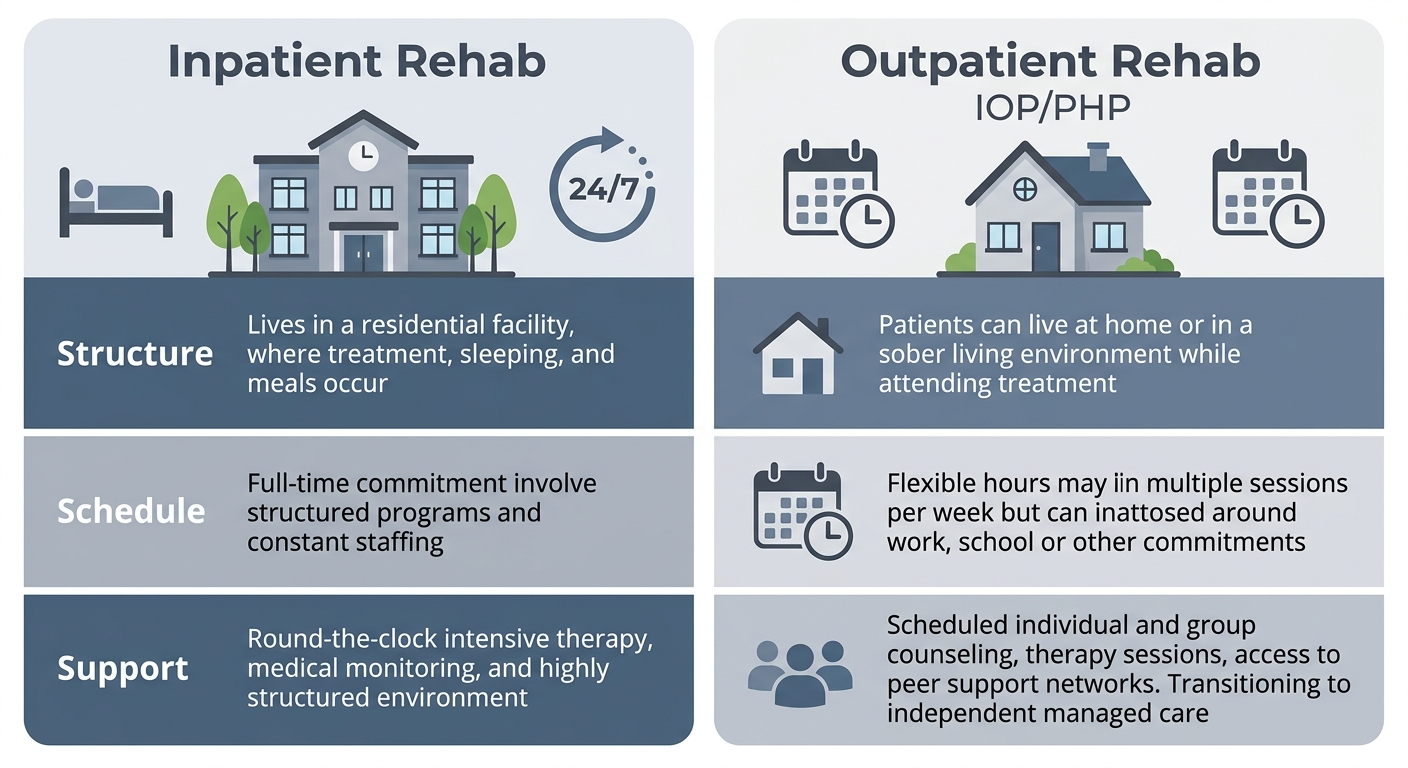
A visual comparison of inpatient and outpatient addiction treatment structures and schedules in Orange County.
We offer a full continuum of care, ensuring that whether you begin in a more structured environment or a flexible outpatient setting, your plan is tailored to you. Pursue the Freedom of Recovery.
This site and its content are not a substitute for professional medical or psychiatric care. Consult a healthcare professional for diagnosis and treatment.
2. The Role of Dual Diagnosis Treatment in Recovery
Effective recovery from addiction often requires more than just addressing substance use. For many individuals, mental health conditions like anxiety or depression are deeply intertwined with their substance use disorder. Drug rehabs in orange county increasingly recognize that treating one condition while ignoring the other can undermine the recovery process. At Blue Coast Behavioral Health, we understand that these co-occurring disorders often interact and worsen each other, making an integrated approach essential. Because dual diagnosis treatment addresses both conditions simultaneously, it helps individuals build a more stable foundation for lasting well-being.
This integrated approach begins with a comprehensive clinical assessment. Our team identifies the specific ways substance use and mental health symptoms are connected, then tailors a plan utilizing evidence-based therapies. Treating only one condition often leads to relapse, whereas integrated mental health and addiction care works to manage both together. This model of co-occurring disorder treatment can support long-term wellness by equipping individuals with the coping strategies needed for both issues. As part of a full continuum of care, an intensive outpatient program orange county residents trust can offer the structured dual diagnosis care necessary for sustainable change.
Understanding the role of dual diagnosis treatment is the first step; next we will explore how our integrated approach works in practice. For those seeking comprehensive care, our orange county addiction treatment program offers dual diagnosis services designed to support your journey. If you or a loved one need immediate assistance, the Substance Abuse and Mental Health Services Administration (SAMHSA) provides a free, confidential National Helpline. Results may vary; past or anecdotal results do not guarantee similar outcomes.
3. What to Expect During the Intake Process
Taking the first step toward recovery is a courageous decision, and finding the right support among drug rehabs in Orange County can feel overwhelming. At Blue Coast Behavioral Health, we have designed our intake process to be straightforward, compassionate, and entirely confidential, ensuring you feel safe and respected from the very first moment you reach out.
Your journey begins with a private phone call or an online contact form. During this initial conversation, one of our dedicated intake coordinators will take the time to understand your unique situation by gently gathering essential background information. This includes your medical history, any substance use patterns, and your mental health background, allowing us to begin forming a personalized picture of your needs.
Following this, we will schedule a clinical assessment with a licensed clinician, which can often be conducted face-to-face or via our convenient tele-health platform. This in-depth evaluation goes a step beyond the initial call, allowing the clinician to determine the most appropriate level of care for you. Based on your needs, we may recommend one of our orange county rehab centers that offers an intensive outpatient program in Orange County or specialized dual diagnosis treatment in Orange County that fits your path to recovery. The combined intake steps typically take between 60 and 90 minutes and are always handled in a supportive, non-judgmental environment; our admissions team manages insurance verification separately, so you won’t need to provide payment details during these initial conversations.
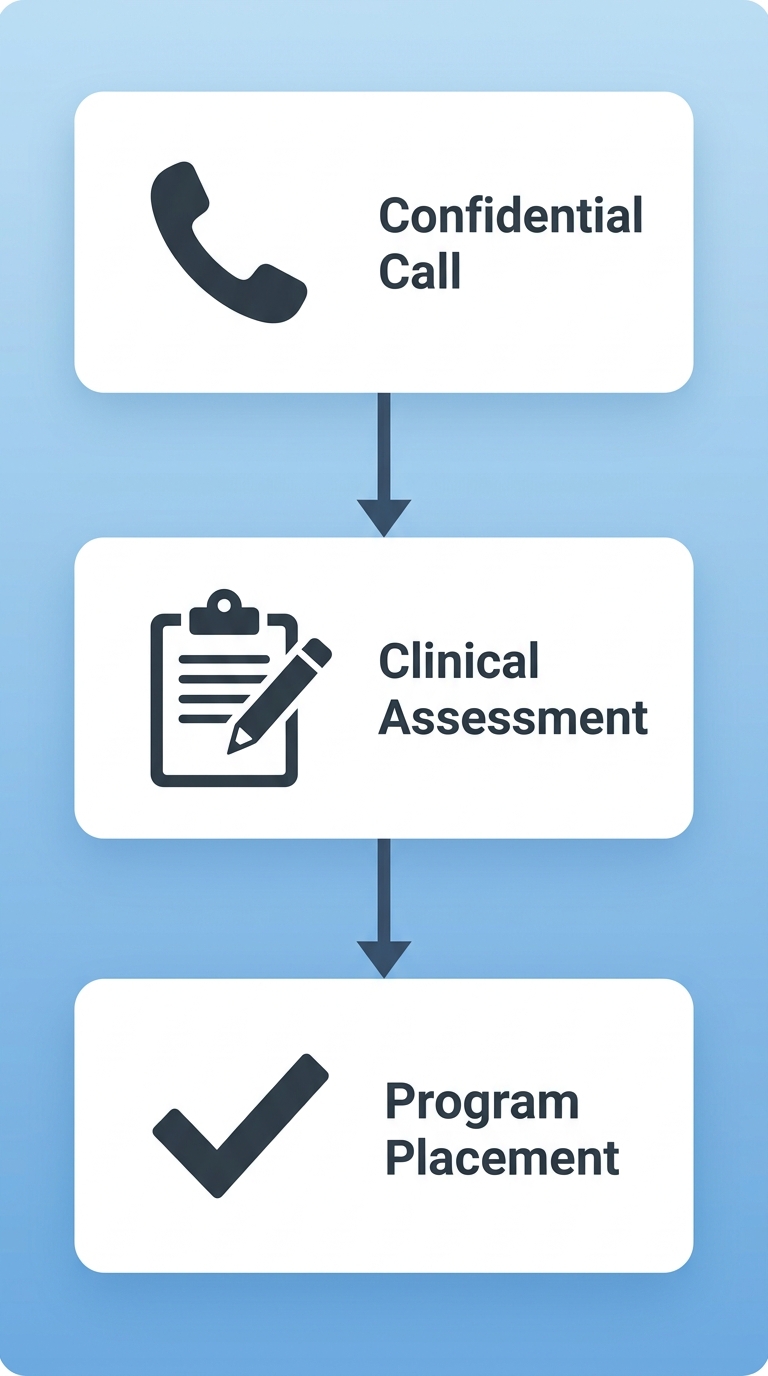
A visual guide to the three key steps of the intake process at Blue Coast Behavioral Health.
After the intake, your dedicated clinician will work with you to determine the best next steps for your recovery, ensuring a seamless transition into a program tailored specifically to your goals. This site and its content are not a substitute for professional medical or psychiatric care.
4. Insurance Coverage for Drug Rehab in Orange County
At Blue Coast Behavioral Health, we believe financial concerns should never stand between you and recovery. We accept most major insurance plans for drug rehabs in Orange County, making our personalized outpatient programs accessible to those ready to begin healing.
Verifying your benefits is a quick, no-obligation process. Simply call our team or complete our online form, and we will contact your provider to confirm coverage details for our outpatient rehab orange county services, including our intensive outpatient program in Orange County and dual diagnosis treatment in Orange County. Coverage varies by plan, so a brief verification call clarifies your benefits–never assume you lack coverage. For those who are uninsured or need additional support, the Substance Abuse and Mental Health Services Administration (SAMHSA) offers a confidential, 24/7 National Helpline at 1-800-662-HELP, providing treatment referrals and insurance guidance.
Once your insurance is verified, you are ready to take the next step toward recovery. Contact Blue Coast Behavioral Health today for personalized insurance verification and Start Your Sobriety Journey Today.
Results may vary; consult a healthcare professional for diagnosis and treatment.
5. How an Intensive Outpatient Program Works
Once determined as a suitable candidate for outpatient care, clients begin a structured weekly schedule that typically includes 9 to 15 hours of programming across 3 to 5 days. We design these schedules with daytime and evening options so participants can continue meeting their work, school, or family obligations while receiving treatment. Because our clients live at home or in a sober living environment and commute to our Newport Beach facility, the program provides a level of flexibility that residential treatment cannot offer.
Our clinical programming integrates several evidence-based components within each week: individual therapy sessions to address personal goals, group therapy to build peer support and communication skills, and family programming that helps repair and strengthen the home support system. For those managing a dual diagnosis, we weave comprehensive care for co-occurring mental health conditions directly into the daily treatment sessions, ensuring mood disorders and substance use are treated together rather than in isolation.
A personalized treatment plan guides every client’s experience and is reviewed regularly with their clinical team, ensuring the intensity and focus of the structured IOP adapts as recovery progresses. Because the intensive outpatient program in Orange County also serves as a step-down option from partial hospitalization or residential care, we tailor the transition to maintain stability while increasing real-world independence. For immediate crisis support, SAMHSA’s National Helpline (800-662-HELP) offers 24/7 referrals to local treatment facilities and community resources. To see our welcoming environment for orange county addiction treatment, view our Orange County facility photos.
6. Key Therapies for Substance Use and Co-Occurring Disorders
To address these complex needs, we offer a range of key therapies at Blue Coast Behavioral Health. For those exploring options at orange county rehab centers, we provide an individualized outpatient continuum of care. Many people seeking drug rehabs in Orange County find that effective treatment must simultaneously address mental health conditions.
Our clinical approach integrates individual therapy, including modalities like cognitive behavioral therapy (CBT) and dialectical behavior therapy (DBT), which are personalized to each client’s goals. Group therapy serves as a peer-supported environment for building relapse prevention strategies and practical coping skills. We also emphasize family programming as a key differentiator, providing weekly updates and dedicated family sessions to rebuild communication and trust.
Our dual diagnosis treatment in Orange County directly addresses co-occurring mood and anxiety disorders alongside substance use. Within our intensive outpatient program Orange County clients can access these integrated therapies. Our range of services also includes Medication-Assisted Treatment (MAT) as one recovery option, with 24/7 counselor access to support clients throughout their healing. These therapies form the foundation of a personalized recovery journey supported by ongoing case management.
The content on this page is not a substitute for professional medical advice. If you are experiencing a crisis, the Substance Abuse and Mental Health Services Administration (SAMHSA) National Helpline at 1-800-662-HELP (4357) provides free, confidential, 24/7 support.
Your path to recovery in Orange County begins with comprehensive support and a personalized approach. Whether you are researching drug rehabs in Orange County or exploring an intensive outpatient program Orange County residents can rely on, we build an individualized plan that adapts to your life. Our outpatient continuum integrates dual diagnosis treatment Orange County families trust, targeting the root causes of substance use while reinforcing daily stability. With 24-7 counselor access and weekly family updates, you never have to navigate this alone. Pursue the Freedom of Recovery with a team that meets you exactly where you are, offering structure, accountability, and genuine compassion through every stage of healing. Call today to activate your personalized care plan.
This article was researched and written with the assistance of AI tools.
Resources

Newport Beach
CA
92660